Apple’s iCloud Joins Airways, Inboxes, Banks and a Spy Agency on the Week’s Failure List — Officials Blame Aging Machinery, Not Hackers
By the Regional Intelligence Desk
Washington, Nov. 17 — In a single week, a run of failures touched nearly every system Americans lean on daily — and on Tuesday it reached Apple.
Microsoft 365 went dark worldwide Thursday, Nov. 12, for about a day. On Friday the Federal Aviation Administration halted departures nationwide for nearly five hours, the longest such stop since September 2001.
On Monday a computer fault forced United Airlines to hold departures, and customers of JPMorgan Chase, Bank of America and other large banks reported trouble reaching their accounts. On Tuesday the National Security Agency acknowledged a “temporary degradation” of internal systems during maintenance; mission-critical work, it said, was unaffected.
Then, late Tuesday morning, iCloud sign-in failed for all of Apple’s users, and the App Store, Apple Pay and other services faltered for hours. Apple said an internal update was to blame.
Hours earlier, Homeland Security Secretary Markwayne Mullin had told CNBC that none of the outages were attacks — new technology laid on very old systems, he said, “98% certain” — and predicted more such failures.
What this paper concludes. Seven failures in a week invite suspicion. But timing alone proves nothing. Each has its own explanation from the organization responsible, and no common technical evidence links them.
This edition rates the cluster High for its effect on daily life and Low for evidence of coordination. Aging systems that fail on their own are a security concern in themselves, whatever the cause.
HSR-0001-P1 · He Still Reigns™ · Global Security & Resilience Review · hestillreigns.com/paper/vol-1-no-1/#front
War in Europe
Bridge to Crimea Broken
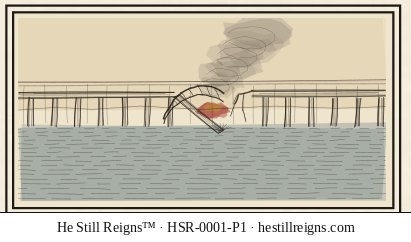
Road Arch Falls Into the Strait After Two Days of Ukrainian Strikes
Kerch Strait, Nov. 17 — Ukraine struck the Kerch Bridge, Russia’s road and rail link to occupied Crimea, on consecutive days, Monday and Tuesday.
Images verified by NBC News and CNN show a road section collapsed into the water. Ukraine’s Security Service says a metal arch and roadway were destroyed and the rail section damaged; no independent assessment has been published.
President Zelenskyy called it an unprecedented operation, in retaliation for Russian strikes on Ukrainian infrastructure. Rail traffic resumed on one track as Russia planned repairs.
HSR-0001-P1 · He Still Reigns™ · Global Security & Resilience Review · hestillreigns.com/paper/vol-1-no-1/#front
The Gulf · Late News
U.S. Jets Strike Iranian Missile Site
Raid on Qeshm Island Follows Iran’s Third Drone Attack on Bahrain in a Week
Washington, Nov. 17 — U.S. fighter jets struck a Revolutionary Guards missile launch site on Iran’s Qeshm Island on Tuesday, a U.S. military official said, calling it a response to attacks on American personnel and assets. An Iranian provincial official confirmed the strikes, the third on Qeshm this month.
Hours earlier the Guards sent drones at a U.S. radar at Bahrain’s Sheikh Isa Air Base. Central Command said they were downed without damage or injury, as in attempts on Friday and Sunday.
The two sides have traded strikes for weeks without returning to the war’s early intensity. Vice President Vance said the president will not allow a “forever war.”
Escalation concern HIGH · rising
Sources: Bloomberg; ABC News; Washington Examiner — Nov. 17, 2026.
HSR-0001-P1 · He Still Reigns™ · Global Security & Resilience Review · hestillreigns.com/paper/vol-1-no-1/#front
Page 2
The Week America Went Offline
Seven separate failures in seven days — and what the record does and does not show
Thursday12 Nov.Microsoft 365Outlook and Teams down worldwide for about a day.
Friday13 Nov.FAANationwide ground stop, 3:30 to 8:15 p.m. Eastern.
Monday16 Nov.UnitedComputer fault halts many departures.
Monday16 Nov.BanksChase software bug; other big banks report access trouble.
Tuesday17 Nov.NSAInternal systems degraded in maintenance, agency says.
Tuesday17 Nov.Weather ServiceWebsites and data down 40 minutes after maintenance.
Tuesday17 Nov.AppleiCloud sign-in fails for all users; internal update blamed.
Aviation
The Day the Skies Stood Still
One Router in Arkansas, a Flood of Data, and Twelve Thousand Canceled Flights — The FAA Gives Its Own Account
Washington — At about 3:30 p.m. Eastern on Friday, Nov. 13, the Federal Aviation Administration ordered every departing flight in the United States to stay on the ground. It was only the second nationwide ground stop since the September 11 attacks; the last, in January 2023, lasted about 90 minutes. This one lasted until 8:15 p.m.
The FAA says its legacy equipment became unstable when a flood of data — roughly 1,000 connection attempts every four to five seconds — hit its telecommunications network.
The initial investigation points to two places: a radar site in Amarillo, Texas, and a radio communications site in El Dorado, Arkansas, where the agency’s network contractor, L3Harris, was installing a new router. L3Harris blocked both locations and the network stabilized. The root cause remains under investigation.
Transportation Secretary Sean Duffy said investigators are working out whether an installer erred or the router itself was faulty. L3Harris says it is supporting the inquiry, and FBI cyber teams are giving technical help.
The FAA said there was no indication of a cyberattack or outside actor, attributed the failure to its legacy system rather than its modernization work, and disabled the suspect router function on about 60 similar routers. The router was swapped in daytime; the agency will reconsider that. Airlines needed the rest of the weekend to work through the backlog.
HSR-0001-P2 · He Still Reigns™ · Global Security & Resilience Review · hestillreigns.com/paper/vol-1-no-1/#offline
Business & Technology
The Rest of the Week, Failure by Failure
Microsoft (Nov. 12–13): a network capacity upgrade exposed a hidden software bug, the company said in a preliminary finding, and it said no attack or AI was involved. It then warned of phishing emails exploiting the outage.
The banks (Nov. 16): JPMorgan traced its payment trouble to a software bug. Customers of Bank of America, U.S. Bank, Capital One, Truist, Wells Fargo and the Zelle app also reported problems; service was back to normal by Tuesday morning.
United (Nov. 16): a computer problem halted many departing flights, Reuters reported; service has since been restored.
The NSA (Nov. 17): CNN, citing six people, reported its classified network down, with no sign of an attack. The agency cited a temporary degradation during scheduled maintenance and said mission-critical capabilities stayed up. Scope and duration are unverified.
The Weather Service (Nov. 17): websites and data feeds went down for about 40 minutes after routine network maintenance.
Apple (Nov. 17): from 11:45 a.m. Eastern, iCloud sign-in failed for all users, and the App Store, Apple Pay, Apple Music and iCloud Mail were disrupted; the App Store was back by about 1 p.m. Apple said an internal update was the cause.
Reported, not confirmed: Gmail and Marriott complaints spiked on Downdetector; neither company confirmed a problem.
For depositors: a delayed transaction is not missing money. Check balances with your bank directly, and ignore outage-themed messages asking you to “verify” an account.
Sources: Fourweekmba and Bernama (Microsoft), Nov. 14; CBS News, Nov. 17; Reuters, Nov. 17; CNN, Nov. 17; Fox News, Nov. 17; BleepingComputer, AppleInsider and Yahoo Tech, Nov. 17, 2026.
HSR-0001-P2 · He Still Reigns™ · Global Security & Resilience Review · hestillreigns.com/paper/vol-1-no-1/#offline
Editorial
Of Faults and Foes
How This Paper Weighs a Claim of Sabotage
A credible attribution of attack requires technical indicators, forensic evidence, an access path and independent corroboration. Coincidence of timing is not enough.
When services fail together, ask first whether they share a provider, a routing layer or a maintenance change. This week nearly every failure traces to an update. These are official assessments, not completed forensic findings: they make a coordinated attack unlikely, not impossible.
The real attacks were quieter. Microsoft’s Nov. 10 update fixed an Outlook flaw attackers were already exploiting; CISA ordered federal agencies to patch by Nov. 24. Install it at home and at work.
Still pending: Microsoft’s final report, the FAA and L3Harris findings, and Apple’s full account.
Sources: SecurityWeek; Dark Reading, Nov. 10, 2026.
HSR-0001-P2 · He Still Reigns™ · Global Security & Resilience Review · hestillreigns.com/paper/vol-1-no-1/#offline
Page 3
Foreign Dispatches
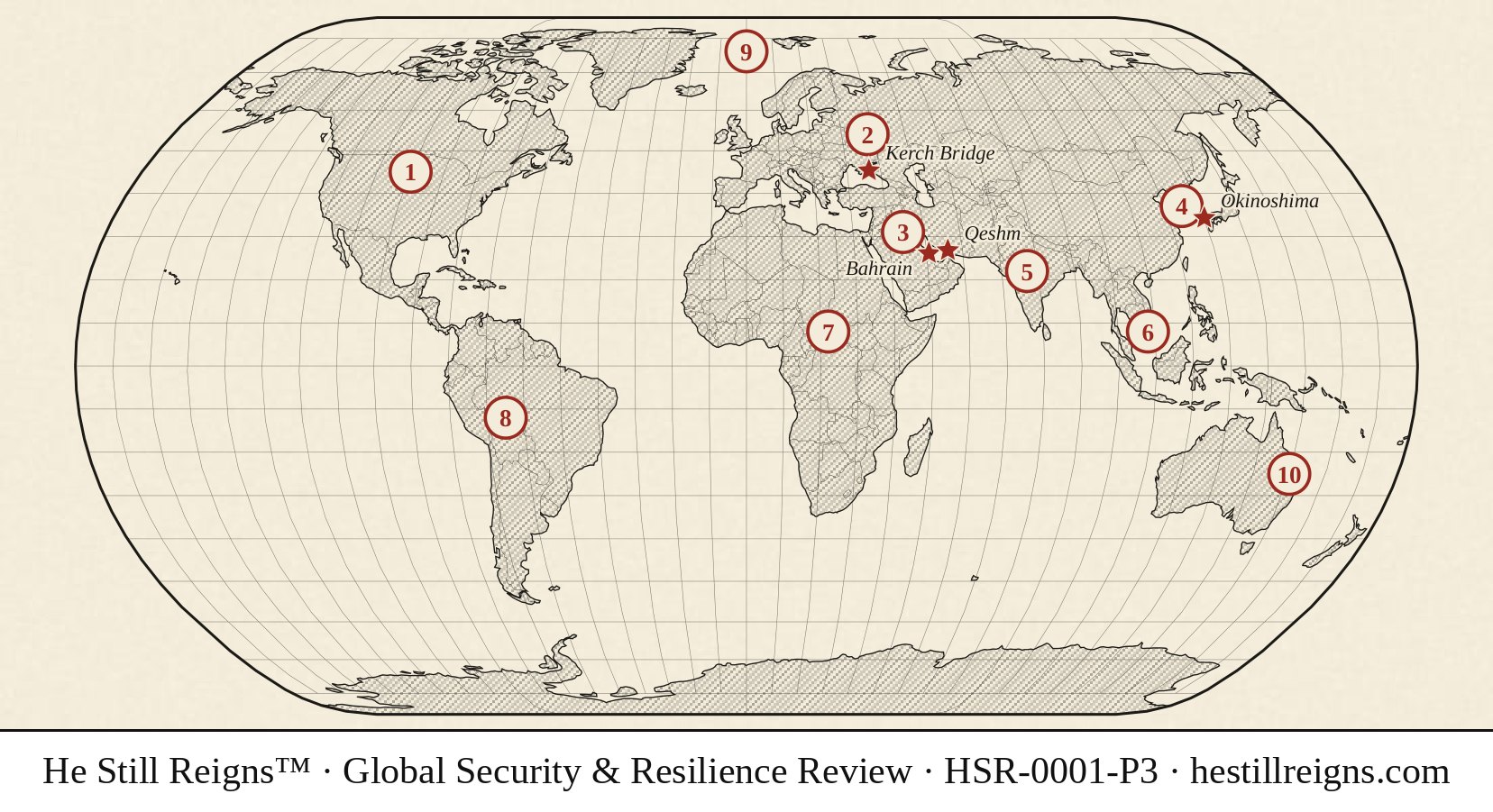
The Global Watch — ten regions, one consistent method
Active: a verified incident this week. Ongoing: sustained conflict or pressure, no single new event that changes the picture. Baseline: structural exposure only. Stars mark this week’s incidents.
1
1. North America
Active
Exposure: cross-border commerce, heavy dependence on shared cloud, payment and air-traffic networks.
Latest: seven U.S. outages in seven days (Page 2), the latest at Apple on Tuesday, showed how many services ride on the same networks and vendors. Officials and the companies report separate causes; no hostile link has been shown.
Why it matters: Canadian and Mexican commerce runs on many of the same U.S. platforms. A failure in one country’s backbone does not stop at the border.
Ahead: the president hosts the G20 summit at his Doral resort near Miami, Dec. 14–15.
Watch for: the promised post-incident reports, and any new failures that share a technical cause.
2
2. Europe & Russia
Active
Exposure: the Russia–Ukraine war, NATO’s eastern frontier, energy security.
Latest: a road span of the Kerch Bridge fell into the strait after strikes Nov. 16–17, and Kyiv was heavily bombarded overnight. On Nov. 11, NATO scrambled jets after at least four drones strayed into Baltic airspace during Ukrainian strikes on Russia; Kyiv says Russian jamming knocks its drones off course.
Diplomacy: U.S.-brokered Ukraine–Russia talks in Abu Dhabi on Nov. 10–11, the first since February, produced no energy truce; Zelenskyy said Russia’s delegation claimed it lacked the authority. U.S. envoys Steve Witkoff and Jared Kushner met Putin in Moscow on Nov. 12.
Context: an International Institute for Strategic Studies study plotted 144 suspected drone sightings across Europe from 2024 to 2026, some likely launched from Russian “shadow fleet” ships.
Watch for: Russian retaliation for the bridge; drones over NATO soil; whether Ukraine comes up at Thursday’s three-power meeting (Page 4).
3
3. Middle East
Active
Exposure: the war with Iran, now in its ninth month; Gulf shipping; U.S. bases and the Fifth Fleet.
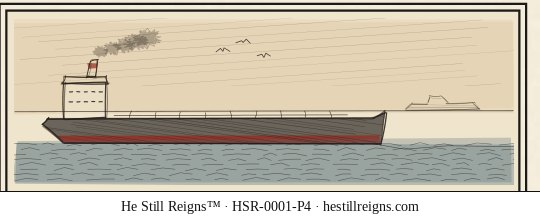
Latest: on Tuesday U.S. jets struck a Revolutionary Guards missile site on Qeshm Island, after Iranian drones were fired at U.S. radar in Bahrain on Nov. 13, 15 and 17, all reported intercepted. On Monday a tanker was disabled by an attack north of Khasab, Oman; its crew was reported safe. Iran says the Strait of Hormuz remains closed; Washington, enforcing a naval blockade of Iran’s ports, rejects that claim.
Diplomacy: stalled. Through a Qatari mediator, Iran has sent seven conditions, among them lifting the U.S. naval blockade and sanctions. On Sunday its parliament speaker said the path to ending the war is open if Washington accepts them; Washington has instead tightened sanctions.
Context: the two sides keep trading strikes despite a June memorandum of understanding, but have not returned to the war’s early intensity.
Exposure: the Taiwan Strait, Japan, the Korean Peninsula.
Latest: beyond the Russian incursion near Okinoshima (Page 1), Taiwanese officials say China staged a large, unannounced exercise across the western Pacific in early November, at one point massing more than 100 military and coast guard vessels — what Taipei calls “silent intimidation.” North Korea fired several missiles Nov. 4, its fourth launch in a month. On Nov. 11, G7 foreign ministers said China’s activities east of Taiwan threaten regional stability and freedom of navigation; Beijing rejected the statement.
Context: Japan scrambled fighters 442 times from April through September, 152 of them against Russian aircraft.
Ahead: APEC leaders meet in Shenzhen Wednesday and Thursday, with the Trump–Xi–Putin meeting on Thursday (Page 4).
Watch for: named Chinese exercises and closure zones; North Korean long-range tests; anything agreed at Shenzhen.
HSR-0001-P3 · He Still Reigns™ · Global Security & Resilience Review · hestillreigns.com/paper/vol-1-no-1/#dispatches
Sources: Reuters; Al Jazeera (Nov. 15); Bloomberg, ABC News (Nov. 17); IISS via AP; Kyiv Post; USNI News; Kyiv Independent. Full list, Page 6.
Page 4
Foreign Dispatches, Continued
Regions five through ten — and the summit that could move them all
Diplomacy
Three Leaders at One Table
Trump, Xi and Putin to Meet Thursday in Shenzhen — the First Such Meeting of the Three
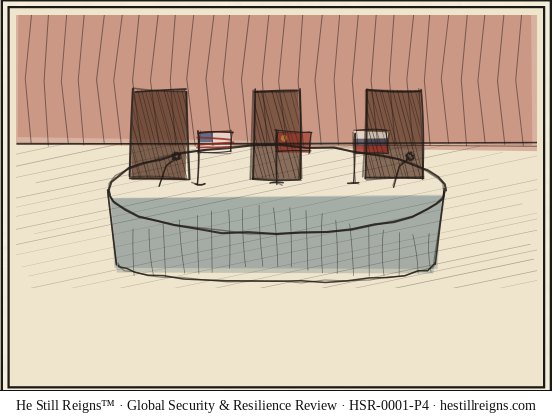
Shenzhen, China — The leaders of the United States, China and Russia will hold their first-ever three-way meeting on Thursday, Nov. 19, on the sidelines of the Asia-Pacific Economic Cooperation summit, the White House confirmed last week. Moscow confirmed Putin’s attendance on Sunday. The APEC business summit opened in Shenzhen on Tuesday, with Xi among a dozen leaders due to speak.
A senior U.S. official said the president intends to raise the war with Iran but steer away from Ukraine. The president has also said he is ready to discuss arms control and denuclearization.
For this paper’s readers, the meeting touches nearly every active region on these pages: the Gulf, Ukraine, the Taiwan Strait and the Korean Peninsula. Nothing is promised. This paper will report what is agreed — and what is merely said.
HSR-0001-P4 · He Still Reigns™ · Global Security & Resilience Review · hestillreigns.com/paper/vol-1-no-1/#dispatches-2
5
5. South Asia
Ongoing
Exposure: the nuclear-armed India–Pakistan rivalry; Pakistan’s border war with Taliban-ruled Afghanistan; terrorism.
Latest: Pakistani and Taliban forces have clashed repeatedly along the border since Oct. 29, and a Pakistani Taliban attack on Nov. 11 killed 10 police officers. Fighting and closures cut bilateral trade by 95 percent over the past fiscal year. The UN had documented more than 1,100 civilian casualties from cross-border violence in Afghanistan by September.
India–Pakistan: no new crisis is established by the sources reviewed, but the four-day exchange of strikes in May 2025 shows how fast one can start.
Watch for: a mass-casualty attack in either country — the usual trigger — and closures at the Torkham crossing.
6
6. Southeast Asia
Ongoing
Exposure: South China Sea disputes, shipping lanes carrying more than $3 trillion in goods a year, disaster response.
Latest: the Philippine military tracked 29 Chinese navy and coast guard vessels at several disputed features Nov. 3–8. In September, Manila said a Chinese coast guard ship rammed a Philippine government vessel off Palawan.
Why it matters: the Philippines is Washington’s oldest treaty ally in Asia; a serious clash could draw in U.S. forces.
Watch for: collisions, water-cannon attacks, injured crews, and any appeal to the mutual-defense treaty.
7
7. Africa
Ongoing
Sudan: the war between the army and the Rapid Support Forces, under way since April 2023, is the world’s largest humanitarian crisis — some 12 million displaced and 30 million needing aid. The RSF took El Fasher in October 2025, giving it Darfur. Now the tide may be turning in Kordofan: the army and allied forces have broken the RSF siege of El Obeid and on Nov. 13 retook Al-Khuwai.
The Sahel: an al-Qaeda affiliate, JNIM, has strangled fuel routes into Mali since September 2025. By mid-2026, military-escorted convoys were bringing in about 200 to 300 tankers a week.
Watch for: aid access, famine declarations, and spillover toward coastal West Africa.
8
8. Latin America & Caribbean
Ongoing
Latest: Venezuela is led by acting president Delcy Rodríguez since U.S. forces captured Nicolás Maduro on Jan. 3. On Oct. 29 she promised elections under a renewed electoral authority but set no date; opposition leader María Corina Machado returned to the country Oct. 25.
Exposure: cartel violence, U.S. strikes on suspected drug boats, port security, migration, power reliability.
Weather: the hurricane season, ending Nov. 30, has been one of the quietest on record.
Watch for: an election date in Caracas, unrest, and country-specific reporting — never one locality standing for the region.
9
9. Arctic & Polar
Ongoing
Latest: Greenland’s parliament on Nov. 3 ratified, 16–0, the security agreement it signed with the United States and Denmark on Sept. 22, which widens U.S. military access to the island. Denmark’s parliament is set to cast its final vote Thursday, Nov. 19.
Context: new shipping lanes are opening and Russia is building up its forces. Denmark’s Arctic commander calls tracking Russian and Chinese submarines through the North Atlantic gap between Greenland, Iceland and Britain the chief task.
Watch for: the Danish vote, new U.S. sites, Russian Northern Fleet activity.
10
10. Oceania & Pacific
Baseline
Exposure: military basing, long supply lines, cyclones — and the undersea cables that carry nearly all data to and from the islands.
Context: every Pacific Islands Forum member is now linked by undersea cable. A U.S. congressional commission warned in September of Chinese “gray-zone” threats to trans-Pacific cables. Australia signed a defense alliance with Fiji in July and opened treaty talks with the Solomon Islands, which has a security pact with Beijing.
Watch for: cable faults, new security pacts, cyclones.
HSR-0001-P4 · He Still Reigns™ · Global Security & Resilience Review · hestillreigns.com/paper/vol-1-no-1/#dispatches-2
Energy
Oil, Ships and the Price of Distance
War near the Gulf’s shipping lanes moves insurance rates, freight schedules and fuel prices well before any cargo is lost. How far the shock travels depends on real route closures, production and market response — not on rhetoric.
This paper watches verified vessel incidents and official maritime advisories rather than treating every military statement as an interruption of supply.
HSR-0001-P4 · He Still Reigns™ · Global Security & Resilience Review · hestillreigns.com/paper/vol-1-no-1/#dispatches-2
Sources: Long War Journal (Nov. 12); AP; GMA News (Nov. 10); Al Jazeera; Institute for Security Studies; MercoPress (Oct. 29); World Defense News; Devpolicy; Janes; USCC. Full list, Page 6.
Page 5
The Home Front
United States Regional Watch — exposure, this week’s ties, and the season ahead
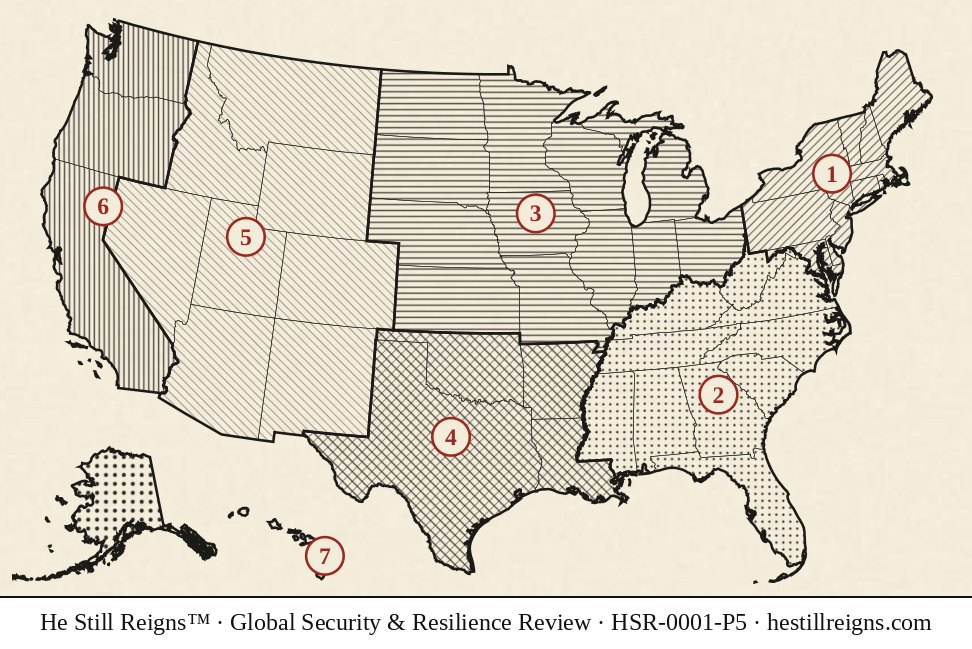
1 Northeast · 2 Southeast · 3 Midwest & Great Lakes · 4 South Central · 5 Mountain West · 6 Pacific Coast · 7 Alaska & Hawaii
1
1. Northeast
Baseline
Exposure: dense population, finance, transit, government and port systems.
This week: three of the week’s failures sit here — JPMorgan Chase in New York, the NSA at Fort Meade, Md., and the National Weather Service in Silver Spring, Md.
Season: NOAA favors a warmer, wetter winter along the coast — more rain and ice, perhaps less snow.
Watch for: nor’easters, ice on power lines and the rail corridor, payment-system notices.
2
2. Southeast
Baseline
Exposure: coastal storms, power grids, ports, logistics, defense installations.
This week: Charlotte-based Bank of America and Truist were among the banks with reported outages Monday.
Season: the year’s only Atlantic hurricane, Isaias, struck Destin, Fla.; NOAA leans toward a wetter winter here.
Why it matters: heavy winter rain brings flooding and severe storms inland as well as on the coast.
Watch for: flood and severe-weather warnings, port and grid notices.
3
3. Midwest & Great Lakes
Baseline
Exposure: manufacturing, freight rail and barge, power, water, winter storms.
This week: United Airlines, whose computer fault halted departures Monday, is headquartered in Chicago, where it runs its O’Hare hub.
Season: NOAA favors a milder-than-normal winter for the Midwest and Mississippi Valley.
Watch for: freight bottlenecks, winter grid peaks, lake-effect storms, which still come in mild winters.
4
4. South Central
Baseline
Exposure: Gulf energy, pipelines, border logistics, severe weather.
This week: the FAA’s inquiry centers on two sites here — a radar in Amarillo, Texas, and a radio site in El Dorado, Ark.
Why it matters: with the Strait of Hormuz contested, Gulf Coast refining and export capacity carries extra weight.
Watch for: refinery or pipeline outages, flash floods in a wet winter.
5
5. Mountain West
Baseline
Exposure: water systems, wildfire, remote communications, defense sites such as NORAD in Colorado.
Season: next year’s water depends on this winter’s snowpack. NOAA’s wetter outlook includes the Southwest.
Why it matters: distance and terrain stretch out repairs after any local failure.
Exposure: major ports, technology, earthquakes, wildfire, Pacific logistics.
This week: both bookends of the week’s failures are based here — Microsoft in Redmond, Wash., and Apple in Cupertino, Calif.
Season: NOAA favors a warmer Pacific Northwest and a wetter California.
Watch for: heavy storms, and flooding or mudflows on burned hillsides; port slowdowns.
7
7. Alaska & Hawaii
Baseline
Exposure: remote supply chains, strategic defense, seismic and volcanic hazards.
Why it matters: both sit closest to this week’s Pacific pressure and depend on undersea cables and long resupply routes. Hawaii hosts U.S. Indo-Pacific Command.
Season: NOAA favors a warmer-than-normal Alaska winter.
Watch for: cable faults, foreign military flights near Alaska, volcanic advisories.
HSR-0001-P5 · He Still Reigns™ · Global Security & Resilience Review · hestillreigns.com/paper/vol-1-no-1/#home-front
Infrastructure
When One System Falls, Others Follow
Power grids, water treatment, telecommunications, hospitals, fuel terminals and freight networks lean on one another. A regional failure can cascade into payments, deliveries and health care far from where it began.
This week proved the point: one network change at a remote site grounded a nation’s airliners. In judging any outage, this paper weighs duration, footprint, people affected, backup capacity and restoration progress — and does not assume a local failure is a national one.
HSR-0001-P5 · He Still Reigns™ · Global Security & Resilience Review · hestillreigns.com/paper/vol-1-no-1/#home-front
Every region is held to the same eight categories; no regional severity is printed without current local evidence.
Page 6
The Reader’s Almanac
Practical readiness, the week ahead, and how this paper keeps itself honest
Preparedness
Ready for a Short Outage
A Household Checklist for Days When the Wires Fail
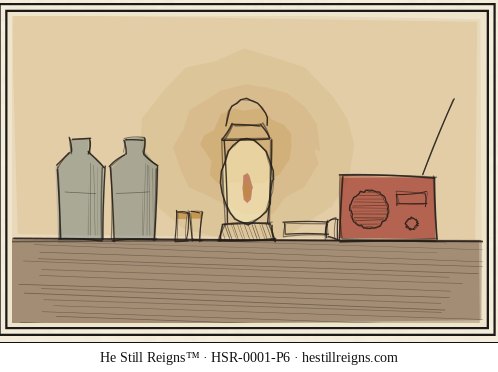
Most disruptions are short and local. A little preparation turns them from a crisis into an inconvenience. Tailor the list to your local weather and your family’s health needs.
Water — a stored supply for drinking and sanitation.
Medicines — keep prescriptions from running down to the last dose.
Light — flashlights and spare batteries rather than candles.
Power — charged battery packs and a way to charge phones.
Communication — a family plan, and phone numbers written on paper.
Payment — more than one method, including some cash.
Alerts — verify through official channels; skip panic buying.
The car — a blanket, water, a phone charger, and a full tank before a forecast storm.
Accounts — know how to reach your bank by phone if its app is down.
Sources: Ready.gov, emergency preparedness; CDC, generator and carbon-monoxide safety.
HSR-0001-P6 · He Still Reigns™ · Global Security & Resilience Review · hestillreigns.com/paper/vol-1-no-1/#almanac
Outlook
The Week Ahead
What Would Change This Paper’s Judgment
The 72-hour watch
Iran’s answer to the Qeshm strike, and any casualties in the Gulf or Ukraine.
New embassy, travel or maritime advisories.
Confirmed NATO frontier incidents.
Repeated failures with forensic links between them — or a company retracting “internal update” as its explanation.
Any official nationwide alert.
No single indicator proves a crisis is coming. Escalation requires evidence of both intent and capability.
The 30-day outlook
Microsoft’s final incident report and Apple’s full account.
FAA and L3Harris root-cause findings.
Russian repairs to the Kerch Bridge, and any retaliation.
U.S.–Iran talks and the status of the Strait of Hormuz.
HSR-0001-P6 · He Still Reigns™ · Global Security & Resilience Review · hestillreigns.com/paper/vol-1-no-1/#almanac
Method
How to Read This Paper
Every region is judged against the same eight categories. Severity and confidence are rated separately, because a frightening claim is not thereby a credible one.
LOW
Routine conditions; no unusual verified indicators.
GUARDED
A developing issue or baseline exposure.
ELEVATED
Credible indicators or material local disruption.
HIGH
Serious active disruption or potential for escalation.
CRITICAL
A major ongoing crisis or immediate severe impact.
Confidence.High: documented or independently corroborated. Moderate: credible but incomplete. Low: preliminary or uncorroborated. Unknown: too little current reporting to rate. A low-confidence claim is never upgraded merely because its consequences would be severe.
Change tracking starts next week; this edition is the baseline.
A rating is not a probability, and no incident printed does not mean safe.
HSR-0001-P6 · He Still Reigns™ · Global Security & Resilience Review · hestillreigns.com/paper/vol-1-no-1/#almanac
Editor’s Notes
Reporting cutoff. This edition reflects reporting available through 5 p.m. Eastern on Tuesday, Nov. 17, 2026. Events after that hour — including any official finding on the week’s outages — will appear in the next edition. The principal sources, with dates and web addresses, are listed on page 7.
How claims are labeled.Confirmed — documented or independently corroborated, such as verified imagery or an agency’s published figures. Official statement — what a government, agency or company says, attributed to it by name. Claimed, unverified — an assertion by a party to events, printed as theirs. Editorial assessment — this paper’s own judgment, marked in the Severity and Confidence lines.
Corrections log. No corrections to this edition as of press time. Errors found before printing — including a misattributed detail about an earlier airline outage — were fixed and are not carried forward. Readers who find an error may write to the editor; each correction will run, dated, in the next edition, with the original claim and the new evidence.
HSR-0001-P6 · He Still Reigns™ · Global Security & Resilience Review · hestillreigns.com/paper/vol-1-no-1/#almanac
Page 7
Sources of This Edition
The reporting behind this edition, dated and linked · Reporting through 5 p.m. Eastern, Nov. 17
Each entry gives the publisher, the article or document (headline or a short description), and its date. In the digital edition every title is a live link; the web address is printed for readers of paper copies. Where a wire story was read through a partner site, both are named.
More conversations, including topics started by readers, are on the Discussion page. Spot an error? Suggest a correction.
Comments appear after the editor reviews them. Your email is never shown. Please read the comment guidelines and our privacy notice.